
That reality creates one essential question that directly affects timelines and compliance:
Do GCC residents need a visa for Saudi Arabia?
The Direct Answer
Yes. GCC residents do need a visa to enter Saudi Arabia.
Only GCC citizens are exempt from visa requirements.
This distinction is strict, enforced at boarding and entry, and based entirely on passport nationality, not where you live.

GCC Citizens vs GCC Residents: The Difference That Matters
Who is considered a GCC citizen
GCC citizens are nationals of:
- United Arab Emirates
- Saudi Arabia
- Qatar
- Bahrain
- Kuwait
- Oman
They can enter Saudi Arabia without a visa using a passport or national ID.
Who is considered a GCC resident
GCC residents are expatriates living in these countries on residence permits, for example:
- Indian national with a UAE residence visa
- British citizen with a Qatar residence permit
- Pakistani national with Bahrain residency
GCC residency does not grant visa-free entry to Saudi Arabia.
Residency and citizenship are treated completely differently.
Why does this distinction affect visa requirements
Saudi immigration rules are based on passport nationality, not place of residence.
Your UAE, Qatar, or Oman residence card does not override your passport’s visa requirements.
This is a critical point for foreign business owners who assume regional residency simplifies Saudi entry. It does not.
Visa Rules for GCC Citizens Entering Saudi Arabia
If you are a citizen of a GCC country, you:
- Do not need a visa to enter Saudi Arabia
- Can enter using your passport or national ID
- Can stay for short periods for personal or business visits
This applies regardless of where you live.
Visa Rules for GCC Residents (Expatriates Living in GCC Countries)
If you are a non-GCC national residing in a GCC country, you do need a visa to enter Saudi Arabia.
This applies to:
- UAE residents
- Qatar residents
- Bahrain residents
- Kuwait residents
- Oman residents
Your eligibility depends on:
- Passport nationality
- Profession listed on your residence permit
- Validity of your GCC residence visa
Do UAE residents need a visa for Saudi Arabia?
Yes. Unless you are a UAE citizen, you must apply for a Saudi visa.
A UAE residence permit alone does not grant entry.
Do Qatar, Bahrain, Kuwait, and Oman residents need a visa?
Yes. The same rule applies. Residency in these countries does not remove the Saudi visa requirement.
What actually determines eligibility
Saudi visa eligibility for GCC residents depends on:
- Your passport country
- Your job title or profession
- Your residence permit validity
- The type of visa you apply for
This is why two UAE residents can have different outcomes. One may be eligible for eVisa. Another may not.
Saudi eVisa for GCC Residents
Saudi Arabia offers an eVisa option for certain GCC residents. This is often the fastest route for short business visits.

Who is eligible for a Saudi eVisa as a GCC resident?
Eligibility is based on:
- Holding a passport from an approved country
- Having a valid GCC residence permit
- Meeting professional and background criteria
Not all nationalities are eligible.
What documents are required to apply for a Saudi eVisa?
Typically:
- Passport copy
- GCC residence visa copy
- Photograph
- Basic personal and travel details
How long does Saudi eVisa processing take?
- Processing is usually quick, often within a few days
- Validity depends on visa type and category
- Entry may be single or multiple depending on approval
Why are Saudi eVisa applications rejected?
- Ineligible passport nationality
- Expired or near-expiry GCC residence permit
- Profession not matching eligibility criteria
- Incomplete or inconsistent information
This is why many business owners validate eligibility before planning travel, particularly when coordinating Saudi visa and entry requirements.
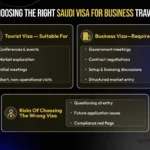
Tourist Visa vs Business Visa: What Business Owners Should Know
This is where many foreign founders make mistakes.
When a tourist visa is acceptable
A tourist visa can be used for:
- Attending conferences
- Exploring the market
- Initial meetings
- Short, non-operational visits
It is not a work permit.
When a business visa is required
A business visa is more appropriate when:
- Meeting government entities
- Signing contracts
- Negotiating partnerships
- Visiting for setup or regulatory discussions
Risks of using the wrong visa type
Using a tourist visa for activities considered business operations can:
- Trigger questioning at entry
- Create issues during future applications
- Raise compliance concerns
For business owners planning structured market entry, visa strategy should align with the broader Saudi business structure strategy.
This is often coordinated alongside company setup, banking, and workforce planning, similar to how regional advisory firms like Profound UAE approach GCC market entry and structuring.
Special Cases and Common Scenarios
Frequent business travelers
If you travel to Saudi Arabia often, a multiple-entry business visa is usually more suitable than repeated tourist visas.
GCC residence permit expiring soon
If your residence visa is close to expiry, Saudi visa applications can be rejected. Validity matters.
Dual passport holders
Your eligibility is based on the passport you use to apply. Some passports qualify for eVisa. Others do not.
Investors and company owners visiting for setup
If you are entering Saudi Arabia to:
- Register a company
- Meet authorities
- Finalize setup steps, aligning travel with business setup in Saudi Arabia is strongly recommended.
This is where many founders align travel planning with their Saudi business setup strategy, often coordinating it with their existing UAE entity or regional structure.
Firms like Profound UAE commonly help founders plan this sequence so travel, licensing, and compliance steps don’t conflict.
Practical Steps for GCC Residents Planning Business Travel to Saudi Arabia
Here is a clean, practical checklist.
- Check your passport eligibility
Confirm whether your nationality qualifies for eVisa or requires a consulate application. - Verify your GCC residence permit validity
Your residence visa should be valid well beyond your travel dates. - Decide the correct visa type
Tourist or business, based on purpose of visit. - Prepare documentation
Passport, residence permit, photograph, travel details. - Apply in advance
Do not leave this to the last minute. - Align travel with business objectives
If visiting for setup, licensing, or negotiations, make sure your visa category supports it.
This planning is especially important for founders using the UAE as a base to expand into Saudi Arabia. Structuring travel, visas, and company formation together, rather than in isolation, avoids delays and compliance issues. This is part of why many regional operators work with advisory partners like Profound UAE when planning cross-border expansion.
Common Mistakes GCC Residents Make
- Assuming residency equals visa-free entry
It does not. - Using tourist visas for business operations
This creates risk. - Ignoring passport nationality rules
Saudi rules are nationality-based, not residency-based. - Applying too late
Visa processing delays can disrupt business schedules. - Not aligning travel with business structure
Entry strategy should match your Saudi expansion plan.
These mistakes are avoidable with basic planning.
Final Takeaway
If you are a GCC citizen, you can enter Saudi Arabia without a visa.
If you are a GCC resident (expatriate), you do need a visa.
This distinction is not flexible. It is strictly enforced.
For foreign business owners, this matters because:
- Entry strategy affects setup timelines
- Visa type affects what you can legally do in the country
- Mistakes create delays and compliance risk
Saudi Arabia is now a core market for many regional founders. Planning travel, visas, and market entry as one coordinated strategy is no longer optional.
Business owners who align their Saudi travel plans with their broader GCC structure, often through advisors like Profound UAE who support regional setup and compliance, move faster and face fewer surprises.
In 2026, clarity is an advantage. Know your status. Choose the right visa. Enter prepared.
Connect with us to ensure your Saudi travel and visa strategy aligns with your broader market entry and compliance goals.
Frequently Asked Questions
Can GCC residents enter Saudi Arabia without a visa?
No. Only GCC citizens are visa exempt.
Is Saudi visa on arrival available for GCC residents?
In some cases, depending on nationality and eligibility, but it should never be assumed.
Do UAE residents get visa-free entry to Saudi Arabia?
Only if they are UAE citizens. Expat residents still need a visa.
Can I work in Saudi Arabia on a GCC resident visa?
No. A GCC residence permit does not allow work in Saudi Arabia.
Does holding a UAE residence permit change Saudi visa rules?
No. Saudi visa rules are based on passport nationality, not UAE residency.
Final Takeaway
If you are a GCC citizen, you can enter Saudi Arabia without a visa.
If you are a GCC resident (expatriate), you do need a visa.
This distinction is not flexible. It is strictly enforced.
For foreign business owners, this matters because:
- Entry strategy affects setup timelines
- Visa type affects what you can legally do in the country
- Mistakes create delays and compliance risk
Saudi Arabia is now a core market for many regional founders. Planning travel, visas, and market entry as one coordinated strategy is no longer optional.
Business owners who align their Saudi travel plans with their broader GCC structure, often through advisors like Profound UAE who support regional setup and compliance, move faster and face fewer surprises.
In 2026, clarity is an advantage.
Know your status. Choose the right visa. Enter prepared.